Weekly Blog Posts
I want you to be informed of ways you can better your health so I will post bi-weekly articles I have written to this page.
Fill out the contact form below to have them delivered right your inbox!
Does good gut health=good brain health?

There is a lot of talk about gut health but what exactly is it and why does it matter if my gut health is good? To start out lets talk about symptoms, what does it look like if my gut health is poor or even problematic at all? You may feel symptoms that are obvious such as abnormal bowel movements, stomach pain after or during eating, or just lethargy after eating. Some of the missed symptoms of poor gut health are ones that may not seem like they could be related but your body is telling you something needs to change. This might be symptoms such as brain fog and trouble focusing, eczema and other skin rashes, bloating, trouble sleeping, anxiety and poor mental health, food sensitivities that are new, and that crazed craving for sugar that refuses to be satisfied no matter how hard you try to curb it.
So what exactly brought you to this point where you have “bad gut health.” This can be many things from imbalance in your food pre/probiotics and gut bacteria, stress, sedentary behavior, alcohol or other recreational drugs, and I hate to say it but often the American processed diet can bring on bad gut health as well. This might be a slow manifestation over time or might creep up fast. I also see patients who went for years with IBS or other irritation to their gut but had no idea that brain fog, anxiety and skin changes could be affected as well. We are also starting to see studies being done and showing that there is a link for bad gut microbiome and brain health and have even seen studies pointing this to potentially causing Alzheimers.
I linked the study below on gut microbiome connection to alzheimers but also wanted to share a little bit about what they found. Essentially they saw that when the gut microbiome was off and did not have enough fiber to convert into short chain fatty acids they noticed that the microglia (cells in the brain) were inflamed more which is one of the causes of alzheimers disease. This does not mean every bad microbiome is the cause of alzheimers nor that if your gut is a mess you will get alzheimers, but it shows that it is important to keep a healthy microbiome to reduce the effects of chronic inflammation on your brain over time.
So what do you do? First off there are a lot of different ways to approach this than I can fit into a small article. The main things you can focus on if you think your gut might be in trouble would be your diet. We tend to feed bad bacteria in our gut with sugar and this can be seen not just in candy but also in simple carbohydrates like white breads and pastas, cereals, French fries/chips and pastries. One easy way to adjust this is to instead get whole grain breads and pastas, leaving the skin on your potatoes and making them at home and eating granola bars instead of cereal. These are small adjustments to your normal diet that can make a big difference to your gut health.
Secondly, you can introduce some foods that have good gut bacteria. This can be seen in things like saurkraut, kefir, pickles and olives, kombucha and some probiotic yogurt. Like I said earlier though, if you are going to eat yogurt make sure you are paying attention to what is in it. If it is loaded with sugar you are not really adding anything beneficial but are adding fuel to the fire. Just because a company advertises probiotics does not mean they withstood the processing process. I also like to recommend pre and probiotics to help your gut health, but if you are buying them they should always have been refrigerated or else they are not living bacteria. There are many vegetable and other ways to get more fiber and prebiotics into your diet, so doing a little research on ways to boost this can help your gut health balance.
Lastly, if you feel your gut health is wreaking havoc I encourage you to see a chiropractor, acupuncturist or nutritionist to help you walk through correcting this. The nerves to your gut come out of the lower back and so adjusting this and making sure that there is limited interference can be helpful for healing your gut health. Acupuncturists can find points that will help the digestive system work at its best and reduce some of the symptoms you may be feeling. As far as nutritional counseling goes sometimes you just need someone to talk through your diet plan and help you walk through ways to improve your gut health and then indirectly your brain health.
https://www.nia.nih.gov/news/beyond-brain-gut-microbiome-and-alzheimers-disease
Headaches are common, NOT normal

I know I have been guilty of this before, and I hear people say it all the time “I have a headache but that is just normal.” I fully believed that I would also have to live with chronic headaches and occasional migraines my whole life. The convenient thing is there are plenty of places to run for relief from this “normal” condition so many people face like Advil, Tylenol, Excederin or if you suffer from chronic migraines some even stronger drugs. The reality is that headaches are not normal, but they are unfortunately common. There is more going on beneath the surface that you are not seeing and that can be addressed which may help reduce the severity and frequency of your headaches. Just because something is common doesn't mean you have to live with it forever! What about chiropractic care for headaches?
It seems strange to think of chiropractic care for headaches if you have never been to a chiropractor for a headache. Chiropractic can be helpful in treatment of headaches from a general tension headache, a cyclical headache or even a migraine from a trigger. There are different approaches we take for each type of headache, but the result should be a decrease in pain. Some of my approach is working with the muscles around the neck and head, doing cranial work (helping the cranial bones move as they should, yes your skull moves!), and depending on your root cause of the headache giving you supplemental information to help avoid these headaches in the future.
According to the World Health Organization 1 in 20 adults suffer from a daily chronic headache, most commonly a tension headache. If you have felt a tension headache you might feel tightness in the back of your head and temples, you might feel some tightness or pain in your jaw, and this tension may also travel down your neck into your trapezius muscles and shoulders. If you are frequently stressed or have a busy day this can exacerbate symptoms even more. I hear it all the time and I also say it all the time; “I carry my stress in my shoulders.” This just begins the creep of pain from the shoulders up to the jaw and head eventually allowing for significant discomfort.
The good news is that chiropractic care can be very beneficial to help with these tension headaches. The approach will be a little different than if you have back pain, but it will help the same way overall. First you will be fully evaluated to get to the bottom of the cause of the headache since different headaches are treated differently in our office. Next we will evaluate whether we need to adjust your neck, upper back or the rest of your spine to make sure your nervous system is functioning well to help this headache go away. One of my favorite things to do when someone is having a tension headache is working on the sub occipital muscles which are super tiny postural muscles at the base of the skull. These muscles get very tight during tension headaches and can cause a lot of the pain. Often when these muscles are addressed the upper cervical (neck) vertebrae move back into place on their own which then relieves some tension on the spinal cord.
Another great tool I use in my office is acupuncture. I have found that acupuncture can also be very helpful for headaches and will help decrease symptoms even while receiving the treatment. This is a great way to help your headaches as well especially if they are recurring. Acupuncture works to help balance your system better so you may not get these headaches as frequently as you did before. Acupuncture is done by using small sterile needles to stimulate points in your body and allow for better energy flow. The needles are very small and most of them are not even felt.
Lastly, something that I mentioned above I evaluate in my office would be cranial work. Your skull has multiple bones that make it up that are joined together by sutures. These sutures can get trigger points along them which may cause pain, as well as the cranial bones can be gently manipulated to help relieve some of the pressure in your head. This is especially helpful if you are having a headache associated with blood pressure. The bones of your skull do not move very much, but if they get restricted in motion this throws everything off all the way down to your jaw since your sutures and cranial bones move slightly when you chew your food.
I hope after reading this you have another option for the next time you have a headache. Headaches do not have to be so common and they are definitely not normal! If you find yourself reaching for the Tylenol the next time your head hurts and you’re stressed, reach for your phone and call your chiropractor instead!

Why see a chiropractor if I am not in pain?
Let’s start small and break it down to the reason why someone comes in to get adjusted. Most of you have been there: you woke up, rolled over and couldn’t move, or you sneezed and felt searing pain down your leg, others might have bent down to tie their shoes and couldn’t get back upright. You come to a chiropractors office and the story is always similar: “I was totally fine and then…”
What you don’t realize is what led to this moment. We live in a very life depleting world. This causes subluxations, think problems with moving the spine, which is what chiropractors treat. The main takeaway is when you have restrictions in your spine they are typically caused from trauma, toxins or stress. By trauma it can be consistently minor instances of trauma like sitting with your legs crossed at your desk, bending over to place and pick up packages all day, even still it could be the person sitting at a desk all day pushing their head forward toward the screen. All of these things are somewhat avoidable, because we have to do our jobs. What we do as chiropractors is help reset the spine motion and allow the nervous system a chance to function better.
All of these little moments have been a small drop in the bucket and for some time you can ignore this and it's fine, until one day you wake up with an overflowing bucket which is seeping into the carpet and invading your everyday life. Each moment on it’s own was small and ineffective, but a cascade of these life depleting moments soon becomes an ocean.This is the moment when pain occurs, this has been going on for months or even years where you consistently had a subluxation from trauma, toxin or stress in your life which was continually putting your spine in a vulnerable position. This can last for a while or even years as our body is intelligent and will then restructure things to make it more stable. This is how arthritis works. Arthritis isn’t just from getting old, it is your body building bone to support an unstable spine/joint. We can help prevent this if early on you consistently get adjusted to keep things moving as close to normal as possible.
Still think you only need to come in when it’s an emergency? That is fine, but there is another reason routine adjustments are beneficial. (I plan to do a break down article in the future for this topic, so stay tuned) A medical doctor who did dissections of 50 cadavers and 22 cats found a correlation of disease to curvatures in the spine. What they found was that essentially wherever there was a diseased organ found in the cadaver they had a curvature in the spine where the nerves came from which supplied that diseased organ. According to Dr. Winsor there was almost 100% accuracy in correlation from the nerve bundle to the respected diseased organ.
Why am I talking about the nervous system if I adjust the spine? This is because the spine houses the spinal cord which is the lifeline for you, it is what keeps you alive and breathing. Every nerve that goes to every limb, organ or tissue comes from within the spinal cord which is within your vertebrae. If you go to a chiropractor they will probably show you a chart where there is a spine and all of the nerves that come out of the spine. These nerves go everywhere and supply everything that gives you life. I have seen patients while in practice people who have other symptoms going on and I palpate and find subluxations over the segment correlating with the nervous system. Sometimes they do not share with me at first, and after a few adjustments they mention that an “unrelated” symptom is getting better after being adjusted.
This does not mean that I think we can cure these diseases because as stated above our world is so life depleting. I do know that keeping the spine healthy can help keep you healthy. This might mean reducing your overall symptoms or preventing further disease. I have seen patients that came in for treatment for a painful spine and later they confessed their digestion was better, their balance was better, their Afib was better, or their muscle cramps were better. These become the lifetime chiropractic patients who realize they do not need pain to get an adjustment and they keep their body functioning a little better through maintenance care.
I understand maintenance chiropractic care is not for everyone and it can be a little weird to try going to the chiropractor for something like balance issues or painful menstruation. I would just say even if you don’t think it can help, might you give it a chance to just let it help prevent pain? What is the loss if you got adjusted once a month to keep your nervous system functioning better when the loss for not doing it could drastically decrease your quality of life. You can flip the script for the unavoidable and help your nervous system stay healthy.
Do you have to “crack” my neck?
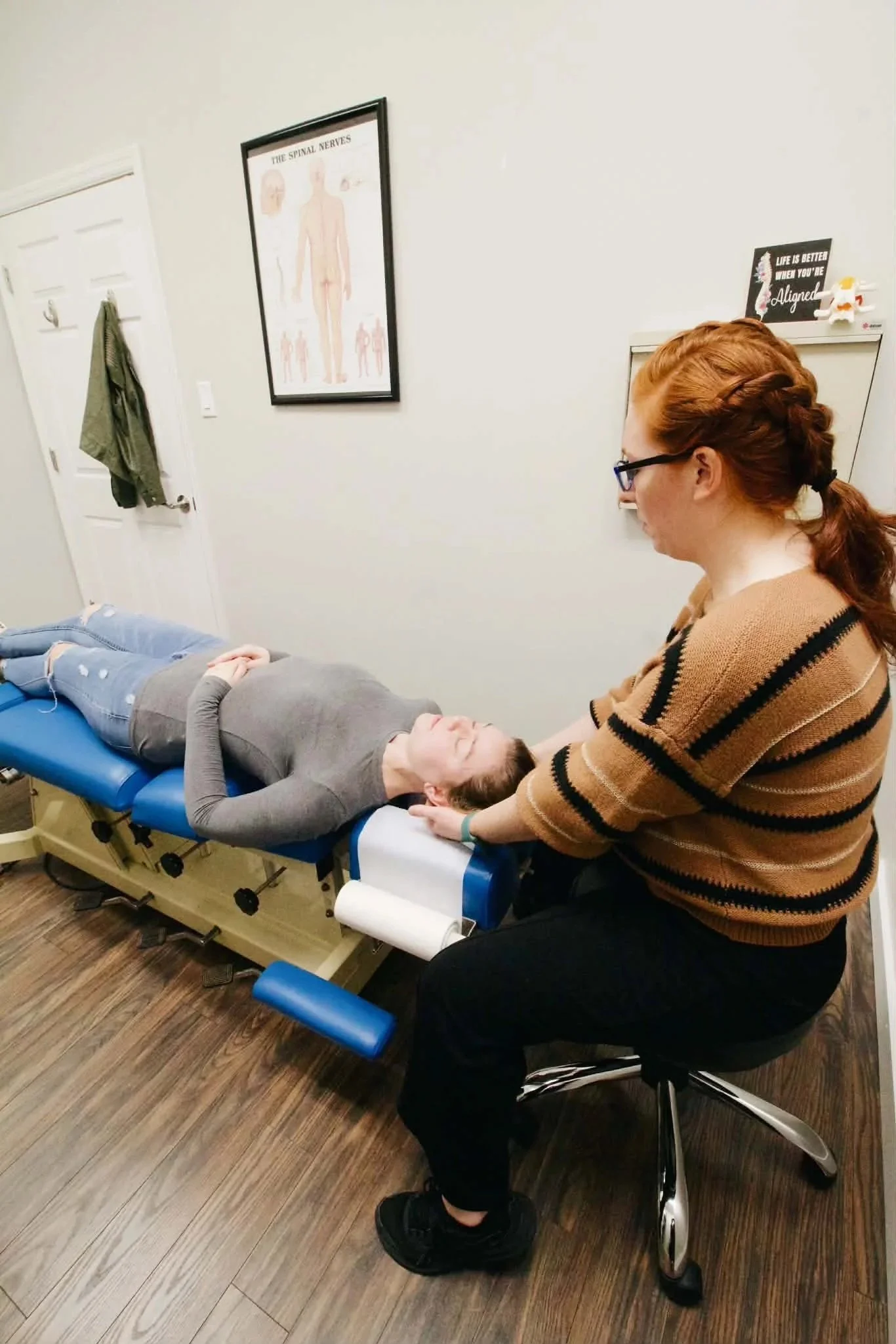
This is a question I get often. There is a lot of information all over the internet of “typical” chiropractic appointments and videos showing how some adjustments go. I think this is a great tool for people to know what to expect when going to a chiropractor, but I do want people to realize that is not the only way an adjustment can occur.
Not wanting a normal neck adjustment is something I can relate to. I come from a family where most of them do not like the sound of an adjustment and prefer a low force adjustment. A low force adjustment is typically done with a tool, pressure and does not have all the twisting and popping you see in most videos. I also personally respond better to low force adjustments rather than the bigger movements and rotations myself. Low force adjustments are a great way to impact the nervous system while keeping you inside your comfort zone. You are not the only person that doesn’t want to hear the popping sound.
You might think that in order for an adjustment to be good it needs to be loud, and often as chiropractors we like to chase this sound as well. Pressure and force into a joint where it is supposed to be is just as beneficial to your nervous system even without a popping sound. Just because your adjustment isn’t noisy doesn't mean your chiropractor didn’t adjust you or that you need that pop for things to be in alignment. There is a lot of research showing the benefits of low force adjustments and how they impact the nervous system and spine the same way the bigger HVLA adjustments do.
Being able to have conversations on how to care for each individual who walks into my office is exactly why I got into chiropractic care. We so often walk into a doctors office and get put through a funnel of the usual questions and get shoved into the box we “should” belong in. The thing is that everyone is unique. Even if we all have the same structures and things going on under the surface, each personality, history and story a patient has is different than the next. It is important for me to know who you are and what you want before we try to shove my favorite treatment onto you, because it may not be the treatment you need. I want to hear your story and meet you in your own personal health journey.
The beauty of chiropractic care is that there are so many extremely intelligent doctors who have spent so much time developing different techniques that are so beneficial to the nervous system. I spent and still spend time learning as much as I can about the different approaches we can take for someone’s health. I understand that everyone has their own reservations, fears or excitement over treatment and I am here to listen and find the best way to help you reach better health. If something isn’t working we will pivot and try something new.
If you are still nervous and would like to know more about different approaches to the “typical” chiropractic adjustment, reach out! We can schedule a free consultation, I can send you videos on different approaches to care and we absolutely will not do anything that makes you uncomfortable. If you are not able to relax during an adjustment your nervous system will not receive it as well as it should, so I want you to be relaxed and able to trust me to care well for your spine. I would love to work through a treatment plan that is specific to you and makes you comfortable while we help your nervous system function better.
One thing I always tell my patients is that if you feel like you want to do something different or something isn’t working for you tell me. You will not offend me if you don’t like how we are doing something. That is the beauty of chiropractic care and the reason that there are so many specialties, there are many ways to hammer a nail into the wall and just as many ways to adjust your spine. Your health is not one size fits all. I would be honored to hear your story and help you on your journey to health. “